
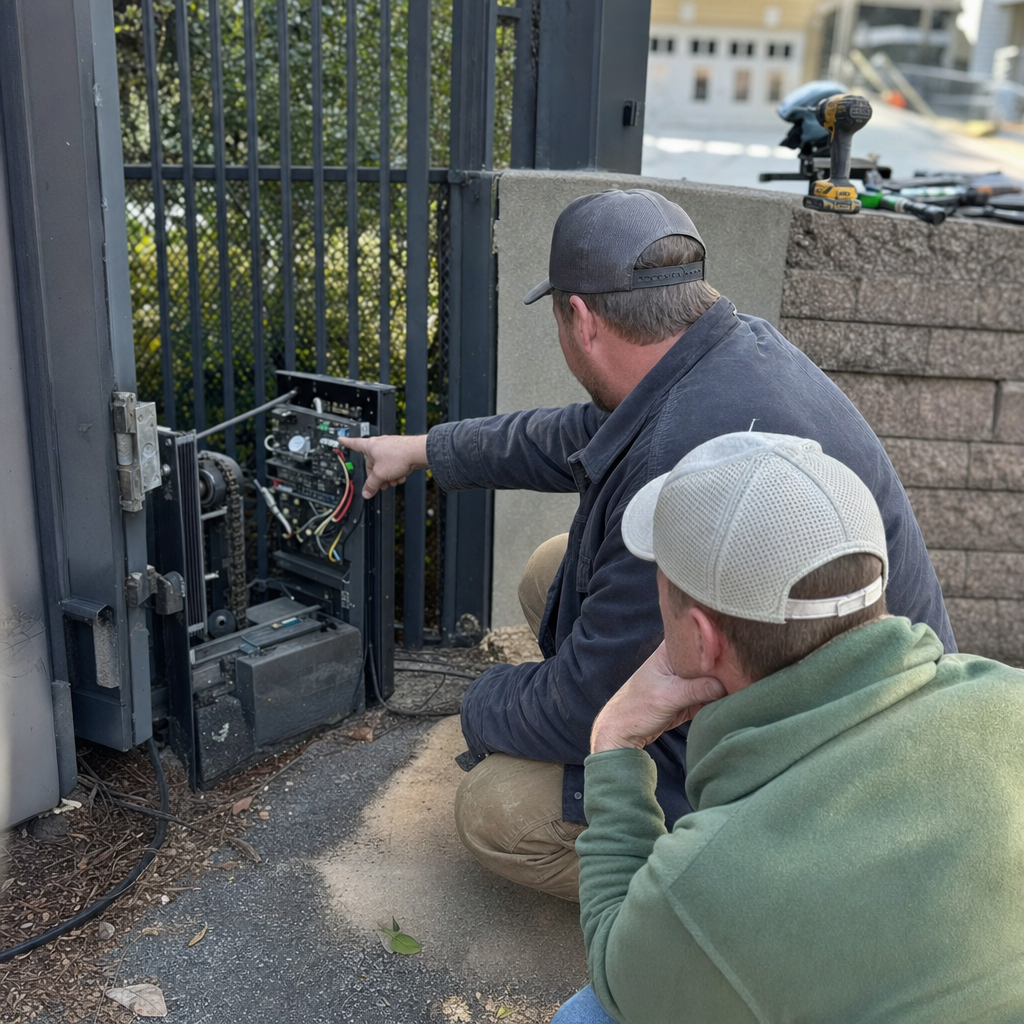
Why Is My Gate Motor Not Working? The Real Causes Georgia Homeowners Overlook
A gate motor that suddenly won’t run is most often a failed run capacitor ($35–$60 part) or a tripped thermal overload from overheating — not the motor itself. In Georgia’s summer heat, we’ve seen motors shut down at 2 PM on a July afternoon in Johns Creek and start working again by dinner, leaving homeowners who paid for emergency calls wondering what happened. If your gate motor hums but won’t turn, or stopped after repeated use on a hot day, the fix is usually simpler than replacement. Call Beacon Gate Repair Georgia at (833) 863-4140 — we’ll diagnose it honestly and only replace what actually failed.

The Sound of Trouble: Three Warning Signs Your Gate Motor Is Dying
Gate motors don’t usually quit without notice. They send signals for weeks — signals that sound like normal wear to an untrained ear. Frank Hughes, Owner & Lead Technician at Beacon Gate Repair Georgia, has spent eight years tracking these patterns across Georgia’s neighborhoods, from the clay-heavy soils of Sandy Springs to the humidity-beaten coastal installations near Savannah. Here’s what to listen for.
Slow Travel Speed: The Capacitor Is Weakening
When your gate takes four seconds to open where it used to take two, the run capacitor is losing its microfarad rating. The capacitor stores the electrical charge that gives the motor its starting torque; as it degrades, the motor strains to reach operating speed, drawing more current and running hotter. In Georgia’s climate, capacitor life runs shorter than manufacturer estimates — summer attic heat in garages near Marietta routinely pushes ambient temperatures past 110°F, accelerating electrolyte breakdown inside the capacitor shell.
We’ve replaced capacitors in Alpharetta homes where the motor was still technically “working” but drawing 40% more amperage than spec. Left unchecked, that excess current overheats the motor windings and turns a $50 capacitor job into a $400–$650 motor replacement. Frank checks the capacitor first, always — it’s the single most common unnecessary expense in gate repair when other companies swap the whole motor without testing.
Grinding on Startup: Gearbox Wear or Lubrication Failure
A gravelly growl when the motor first engages means metal-on-metal contact somewhere in the drivetrain. In worm-drive operators — common in LiftMaster and Elite residential systems — the bronze worm gear meshes with a steel worm shaft. The factory grease breaks down over time, and Georgia’s combination of summer heat and winter humidity accelerates that breakdown dramatically. Heat thins the grease; humidity introduces oxidation. The result is a gear set that sounds like a coffee grinder every morning.
The correct fix isn’t more grease from a hardware store. Different operators need different viscosity grades — NLGI #1 for some gearboxes, #2 for others, and certain FAAC commercial units specify a synthetic base that doesn’t play well with conventional lithium greases. Frank specifies the correct grade for the operator type because the wrong grease can cause more wear than no lubrication at all. We’ve seen homeowners in Roswell pack a gearbox with wheel-bearing grease and destroy a $200 gear set in three months.
Partial Cycle Failure: Limit Switch Drift or Thermal Overload
The gate opens eight feet and stops. Or closes to within two feet of the post and reverses. These partial cycles usually trace to one of two causes: limit switches that have drifted from their set positions, or a thermal overload that’s tripping mid-cycle.
Limit switches tell the motor when to stop. Mechanical switches — the physical lever or cam type found in older Mighty Mule and some DoorKing units — can shift with vibration, temperature expansion, or impact from a gate that hit an obstruction once and never got realigned. Electronic limit systems in newer FAAC and BFT motors store position data in the control board; a power surge or low-voltage condition can corrupt that data, causing the gate to “forget” where fully open or fully closed actually is.
Thermal overload is different. Every gate motor has a duty cycle — typically 20% to 50% for residential units, meaning it can run 2 to 5 minutes out of every 10 without overheating. In Georgia’s July heat, a gate that’s already running hot from a weak capacitor or dragging track will hit its thermal cutoff faster. The motor stops, the homeowner assumes catastrophic failure, and by the time a tech arrives 90 minutes later, the motor has cooled and reset. Frank has taken calls from puzzled customers in Decatur whose “dead” motor started working right before he pulled into the driveway.
Georgia Heat and the Thermal Overload Trap
This deserves its own section because it’s the most misunderstood gate motor behavior in our service area. Here’s exactly what happens: the motor’s internal thermal protector — usually a bimetal disc or PTC thermistor — opens the circuit when winding temperature exceeds a safe threshold. The motor won’t run, won’t hum, shows no signs of life. Thirty to sixty minutes later, the protector cools and closes the circuit. The motor works perfectly.
We’ve had property managers in Buckhead schedule emergency service calls at 2 PM on 95-degree days, only to have the gate operator test normally by 4 PM. The real problem isn’t the motor — it’s usually a combination of factors: the gate is running more cycles than usual (landscaping crews, delivery trucks), the track or hinges need lubrication (increasing motor load), and the ambient temperature is pushing the motor past its thermal design limit.
Key Takeaways:
- Thermal overload looks like total motor failure but is usually temporary
- Check if the motor restarts after 30–60 minutes of cooling before calling emergency service
- Repeated thermal trips indicate an underlying problem — dragging gate, weak capacitor, or undersized operator — that needs professional diagnosis
- Shading the motor housing or improving ventilation can reduce summer thermal trips in exposed Georgia installations
If your motor has thermally tripped more than twice in one summer, there’s a root cause we can identify. Call (833) 863-4140 — we’ll look at the whole system, not just swap parts.
The Capacitor-vs-Motor Distinction: A $50 Fix Disguised as a $600 Problem
A failed run capacitor and a seized motor present almost identically: flip the remote, hear a hum or click, gate doesn’t move. The difference is everything.
The capacitor is a cylindrical or oval component — usually 2″ to 4″ long, often mounted on the motor housing or inside the operator enclosure. It stores a charge that creates the rotating magnetic field the motor needs to start. When it fails, the motor receives power but can’t generate starting torque. It sits there, humming, drawing locked-rotor amperage that would eventually burn the windings if left energized.
Testing requires a multimeter with capacitance function or an analog meter that can measure microfarads against the rating printed on the capacitor shell. Frank carries both and checks this before any other test on a non-running motor. In eight years across Georgia, he’s found that roughly one in three “motor replacement” calls from other companies were actually capacitor failures — homeowners who paid for motors they didn’t need.
| Symptom | Likely Cause | Typical Repair Range |
|---|---|---|
| Hums but won’t start | Failed run capacitor | $35–$60 part + labor |
| Starts slowly, runs hot | Weakening capacitor | $35–$60 part + labor |
| Runs then stops on hot days | Thermal overload (root cause varies) | $85–$250 depending on underlying issue |
| Grinding noise, rough operation | Gearbox wear or lubrication failure | $150–$400 gear set or service |
| No response, no sound, no hum | Control board, power supply, or seized motor | $200–$650+ depending on diagnosis |
We’re transparent about this because there’s no advantage to selling a motor when a capacitor fixes it. Our 4.7-star rating across 570 reviews reflects that approach — customers remember when you save them money, not just when you show up fast.
Brand-Specific Diagnostics: What FAAC and BFT Can Tell Us
Not all gate motors are equally communicative. FAAC and BFT operators — increasingly common in Georgia’s higher-end residential and commercial installations — store fault logs in their control boards. Frank connects a diagnostic interface to pull that data: how many thermal events, which error codes preceded failure, whether the issue is mechanical overload or electrical fault.
Eight years of Georgia service calls means he’s seen the common failure patterns for these brands under local conditions specifically. FAAC 746 and 844 series, for example, tend to show “encoder fault” codes when track debris or hinge binding causes the gate to lag behind the motor’s expected position — the motor thinks it’s lost track of where the gate is, when really the gate is physically resisting. BFT’s ARES and PHOBOS lines log “obstacle detected” events that accumulate when safety edges are maladjusted or when Georgia’s pollen season coats photocell lenses with enough yellow dust to trigger false positives.
This diagnostic capability is why factory training matters. We’re certified to work on nine major gate brands — Gate Motor & Opener systems from LiftMaster, FAAC, BFT, Linear, Viking, Ghost Controls, DoorKing, Elite, and Mighty Mule — so we diagnose fast and fix right instead of guessing.
When to Call a Professional: Electrical Safety and System Complexity
Gate motors operate on 120V or 240V residential power, with some commercial systems at higher voltages. The operator enclosure contains live terminals, charged capacitors that hold voltage even when unplugged, and in some cases battery backup systems with their own electrical hazards. We don’t recommend homeowners open operator housings or attempt capacitor replacement — the risk of shock or creating a fire hazard outweighs the parts savings.
Similarly, adjusting limit switches or clearing fault codes without understanding the safety implications can create situations where a gate closes on a vehicle or person without reversing. Modern operators have force-sensing requirements (UL 325 compliance) that must be verified after any adjustment. Frank tests these settings with calibrated equipment as part of every service call — it’s not guesswork, and it’s not optional.
If your motor has stopped working entirely, shows signs of electrical burning smell, or has exposed wiring from weather damage or pest intrusion, stay clear of the operator and call (833) 863-4140. We’ll assess it safely and give you a straight answer on repair versus replacement.
FAQs
Your motor is likely tripping its internal thermal overload — it cools overnight and works again in cooler morning temperatures, then overheats as ambient temperature rises and cycle demand increases through the day. This pattern is extremely common in Georgia from May through September, especially on gates with southern or western sun exposure. The underlying cause is usually increased motor load from a dragging gate, weak capacitor, or simply running more cycles than the motor’s duty cycle rating allows. Call (833) 863-4140 for a free estimate — we’ll measure the actual load and ambient conditions to find the root cause.
Most gate motor repairs in Georgia range from $85 for a simple capacitor replacement to $400–$650 for full motor replacement with installation, depending on the brand and access difficulty. FAAC and BFT commercial motors run higher due to parts costs and diagnostic complexity. We provide upfront pricing after diagnosis — no surprises, and we always check the capacitor first to avoid unnecessary motor replacements. Call (833) 863-4140 for an exact quote — estimates are free.
We don’t recommend DIY repair on gate motors due to electrical shock hazards from charged capacitors and live terminals, plus the safety risk of improper force or limit settings that can cause entrapment or property damage. Simple maintenance like clearing track debris or cleaning photocell lenses is fine, but anything involving the operator enclosure should be handled by a trained professional. If I can’t explain what’s wrong with your gate in plain English, I haven’t looked at it closely enough — but that explanation happens after safe diagnosis, not before.
You need a new motor if the windings are burned (measured by insulation resistance testing), the gearbox is cracked or has metal contamination throughout, or the motor has been thermally damaged repeatedly. Most other issues — capacitors, control boards, limit switches, lubrication — are repairable at a fraction of replacement cost. Frank tests motor winding resistance, capacitance, and gearbox condition before recommending replacement, and we’ll show you the readings so you understand the decision. Eight years. One trade. Gates only. That focus means we know the difference between a dying motor and a fixable problem.
From Diagnosis to Done: What to Expect When You Call
When you call Beacon Gate Repair Georgia at (833) 863-4140, Frank Hughes — Owner & Lead Technician — takes your call and works your job. No dispatchers, no subcontracted crews, no explaining your problem three times to different people. We’ll schedule a diagnostic visit, test your motor and control system on-site, and give you a clear explanation of what failed and why before any work begins.
We carry capacitors, control boards, and common gear sets for all nine brands we service, so most repairs happen same-day. For motor replacements, we stock the most common LiftMaster, FAAC, and Elite residential models and can source others within 24–48 hours. Every repair includes force and safety testing, limit verification, and a written summary of what was done.
570 neighbors have trusted us with their gates — here’s what that volume represents: years of consistent repeat and referral business, not a one-season spike. From a broken weld to a full access control system, we handle every part of the job in-house.
If you’d rather have it looked at, Beacon Gate Repair Georgia offers a no-pressure assessment in Georgia — call (833) 863-4140.
Written by Frank Hughes, Owner & Lead Technician at Beacon Gate Repair Georgia, serving Georgia, GA.