
LiftMaster Gate Repair in Atlanta: A Homeowner’s Guide
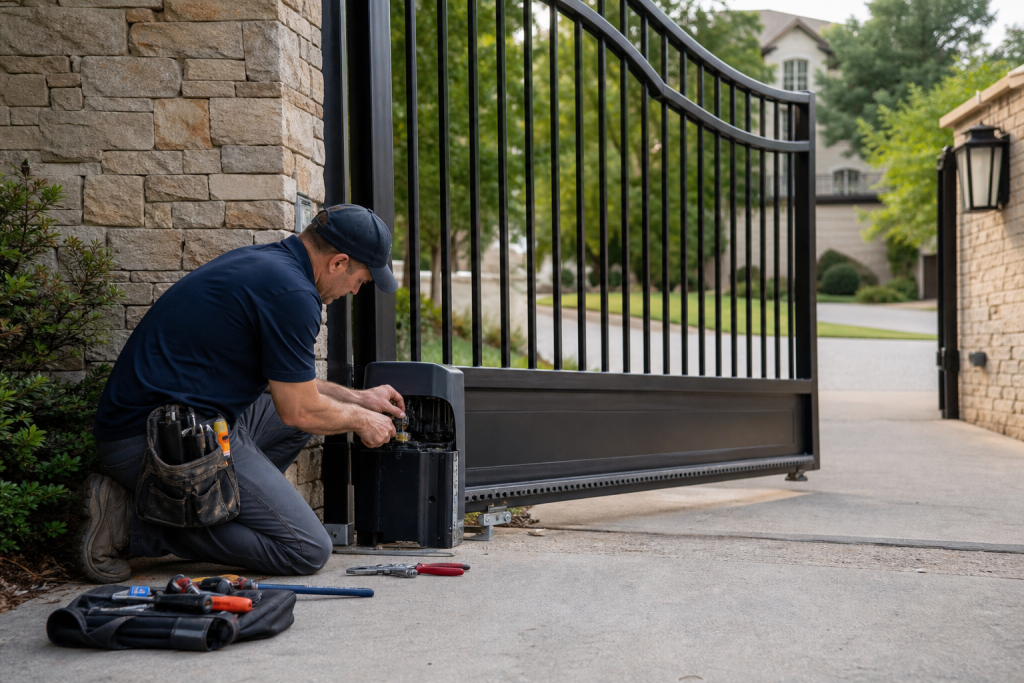
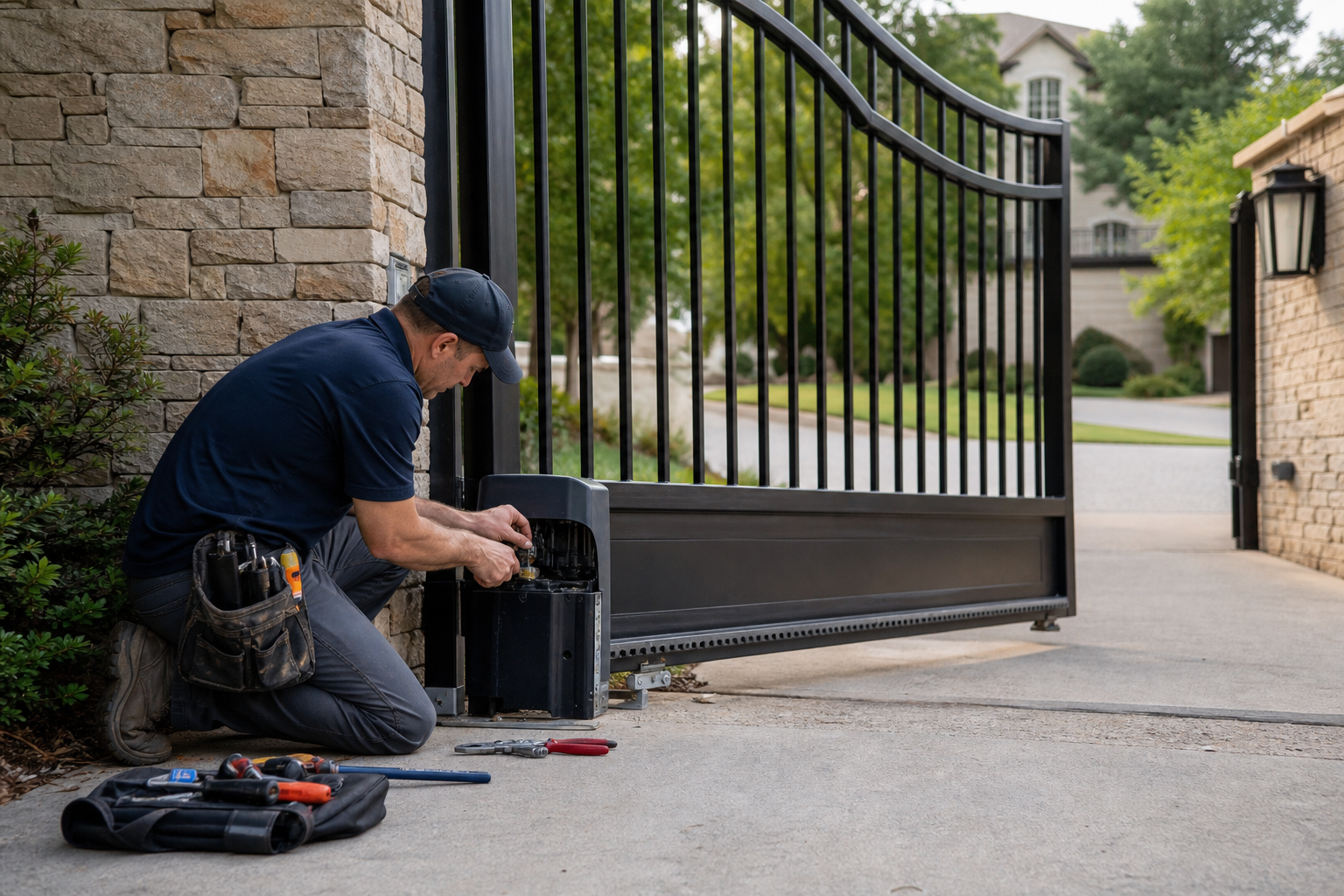
LiftMaster gate repair in Atlanta typically costs $180–$520 depending on whether you’re dealing with a limit switch reset, circuit board replacement, or full operator rebuild. Most issues are fixable same-day, though Georgia’s humidity and lightning exposure create failure patterns that out-of-town technicians often misdiagnose. If you’d rather not troubleshoot yourself, call us at (833) 863-4140 — Frank Hughes handles the diagnostics personally, and estimates are free.
Here’s the thing most Atlanta homeowners don’t realize: the most common LiftMaster repair call we get isn’t a dead motor at all. It’s a corrupted limit switch setting caused by power fluctuations during Georgia’s summer storm season — and it gets misread as a failing operator by technicians who don’t see enough LiftMaster units to recognize the pattern. We’ve had customers in Buckhead and Decatur quoted full operator replacements when a $45 part and 20 minutes of recalibration would have solved it. That gap between symptom and root cause is exactly why gate-exclusive experience matters.
How LiftMaster Systems Age Differently in Atlanta’s Climate
Georgia’s humidity isn’t just uncomfortable — it’s actively hard on gate operators. In our eight years working gates across Atlanta, we’ve tracked clear model-specific wear patterns that don’t show up in LiftMaster’s generic service manuals.
The LA400 series, popular on residential swing gates in neighborhoods like Virginia-Highland and Inman Park, tends to develop condensation in the control housing after 3–4 summers. That moisture corrodes the potentiometer contacts first — you’ll notice the gate stopping short of its limit, or reversing for no apparent reason. The motor itself is usually fine; it’s the position-sensing circuit that fails.
The LA500, common on heavier custom gates in Buckhead and Sandy Springs, shows a different pattern. Its higher torque load combined with Atlanta’s clay-heavy soil (which shifts seasonally) puts stress on the mechanical limit cams. We see stripped cam gears around the 5–6 year mark, especially when the gate post has settled even slightly.
The commercial CSL24UL units we service in industrial parks near Hartsfield-Jackson and along I-85 corridor? Their transformer windings degrade faster here than in drier climates. Not failure — just reduced output that manifests as sluggish cold-weather starts in January and February.
Here’s what we check first on any LiftMaster call in Atlanta:
- Control housing seal integrity — has humidity breached the gasket?
- Limit switch calibration against actual gate travel, not factory defaults
- Surge event history — Georgia averages 50–70 thunderstorm days yearly
- Post stability — clay expansion/contraction throws off mechanical limits faster than operators fail
Reading LiftMaster Diagnostic LED Codes Before You Call
Every LiftMaster operator has a diagnostic LED that blinks in specific patterns when something’s wrong. Learning to read these saves you from paying a trip charge for a two-minute fix — or helps you describe the issue accurately so your technician shows up with the right parts.
Here’s what the most common Atlanta-specific patterns actually mean:
- 1 blink, pause, repeat: Open limit error. In our experience, this is the corrupted setting we mentioned — especially after a summer storm power flicker. Try unplugging the operator for 60 seconds, then plug back in and run the learn sequence. If it returns within a week, the limit potentiometer is degrading and needs replacement.
- 2 blinks: Close limit error. Same root cause, opposite direction. More common on LA500s with heavy gates — the extra momentum overshoots the electrical limit and the system loses its reference point.
- 3 blinks: Obstruction detected. But here’s the Atlanta angle: high humidity can swell wooden gates just enough to increase rolling resistance, especially on older installations in Decatur or East Atlanta. The operator thinks it’s hitting something. Check for binding before you assume the safety sensor is bad.
- 4 blinks: Motor overload. Often misdiagnosed as “motor dying.” Usually it’s a mechanical issue — dry bearings, debris in the track, or that clay-soil gate post shift we mentioned. The motor’s protecting itself, not failing.
- 5 blinks: Control board fault. This one we don’t recommend DIY. Board-level issues in humid environments can involve corrosion spread that’s not visible without disassembly.
If you’re seeing 6+ blinks or a solid red LED, that’s proprietary diagnostic territory — time to call someone who works these units daily.
The Surge Protector Gap: Why LiftMaster’s Built-In Protection Falls Short in Atlanta
LiftMaster operators come with basic surge suppression. In most of the country, it’s adequate. In Atlanta — where the National Weather Service records more cloud-to-ground lightning strikes per square mile than all but a handful of U.S. metro areas — it’s not.
We’ve replaced control boards in CSL24UL units that were “protected” by the factory spec. The built-in MOV (metal oxide varistor) sacrifices itself on the first major hit, and many homeowners don’t realize it’s a one-time fuse, not ongoing protection. After that, the next surge walks straight to the logic board.
What we install on Atlanta LiftMaster systems:
- External panel-mount surge protector with replaceable modules — not the sacrificial type
- Isolated ground run back to the main panel, not just local earth
- Whole-house surge protection at the service entrance for properties with automated gates (the gate operator is often the most expensive single load on the exterior circuits)
The $80–$150 for proper surge protection pays for itself the first time a July thunderstorm rolls through. We’ve seen $600+ board replacements that would have been prevented. One customer in Druid Hills had two boards fail in three years before we traced the root cause — now they’re on year four with zero issues after adding external protection.
Genuine vs. Aftermarket LiftMaster Parts: The 18-Month Difference
This is where we get direct with homeowners because we’ve seen the comparison play out repeatedly. Aftermarket control boards and limit switches for LiftMaster operators are widely available at 30–50% below genuine part pricing. They install fine. They test fine. They often work fine — for a while.
The difference shows up around month 18, typically through an Atlanta summer:
- Aftermarket board capacitors rated for standard humidity degrade faster in Georgia’s 80%+ summer days
- Non-OEM limit switches use lower-grade potentiometers that drift out of calibration more quickly
- Replacement gears in cast zinc instead of OEM-spec alloy wear faster under LA500 torque loads
We warranty our repairs for a reason, and we use genuine LiftMaster parts for a reason. The genuine LA500 control board runs $280–$340 versus $140–$180 for aftermarket. But we’ve done callback-free repairs on original parts that are still running at year five, while we’ve replaced aftermarket boards at 20 months for the same customer.
That said — there are aftermarket parts we do use. Heavy-duty hinges and some mechanical hardware from quality third-party manufacturers can exceed OEM spec. We evaluate part-by-part, not brand-vs.-brand. When we quote your repair, we’ll tell you exactly what we’re using and why.
Repair vs. Replace: When to Be Honest About a LiftMaster Operator’s End
Not every LiftMaster unit deserves another repair. Part of our job is telling you when the math doesn’t work — and we’ve had that conversation honestly with homeowners from Midtown to Marietta.
Here’s our framework:
| Factor | Repair Makes Sense | Replacement Is Honest Advice |
|---|---|---|
| Unit age | Under 8 years | 12+ years, especially pre-2015 models |
| Repair cost | Under 50% of replacement | Over 60% of replacement |
| Part availability | Current model, parts in stock | Discontinued, backordered 4+ weeks |
| Failure pattern | First or second repair | Third or more repair in 24 months |
| Energy/features | Meets current needs | Missing MyQ, battery backup, or safety features you want |
The LA400 and LA500 series from 2018 onward have excellent parts availability and we routinely repair them at year six or seven. But we worked on a CSL24UL from 2012 last month in an industrial park near College Park — the control board was obsolete, the replacement would have been a custom order from a salvage supplier, and the motor was drawing 15% over spec. We told the property manager: repair is possible, but we’d be patching a system that’s past its reliable life. They chose replacement. That’s the call we want our customers to make with full information.
When to call a pro: If your diagnostic LED shows 5+ blinks, if the gate is making mechanical noises you haven’t heard before, or if you’ve already tried the reset sequence and the problem returns within a week. Electrical and high-torsion mechanical work on automatic gates carries real injury risk — the closing force on a residential swing gate can exceed 400 pounds of pressure.
Related services in Atlanta: If you’re considering whether to repair your existing gate or start fresh, our Gate Installation in Atlanta team can evaluate your current setup against new options. For motor-specific concerns, see our Gate Motor & Opener in Atlanta page.
The Bottom Line
LiftMaster builds reliable operators, but Atlanta’s climate and electrical environment create specific failure modes that generic repair knowledge won’t catch. The limit switch corruption from summer storms, the humidity-accelerated component wear, the surge protection gap — these are patterns we’ve documented across hundreds of calls in this market.
Key takeaways if you’re dealing with a LiftMaster gate issue in Atlanta:
- Check your diagnostic LED before calling anyone — 1–2 blinks often mean a reset, not a replacement
- Consider external surge protection if you’ve had any electrical component fail
- Ask your technician whether they’re using genuine or aftermarket parts, and what the warranty covers
- Get a straight answer on repair-vs.-replace math before authorizing major work
- Factor Atlanta’s humidity into your maintenance schedule — what works in Phoenix doesn’t work here
If you’re in Atlanta and your LiftMaster gate isn’t behaving right, Beacon Gate Repair Georgia offers free estimates — call (833) 863-4140. Frank Hughes takes your call, runs the diagnostics, and handles the repair himself. Eight years. One trade. Gates only.
Frequently Asked Questions
Most residential LiftMaster repairs in Atlanta run $180–$340 for common issues like limit switch replacement or control board reset. More complex repairs — circuit board replacement on a CSL24UL, motor rebuild, or structural welding — can reach $400–$520. We provide upfront pricing after diagnosis, and estimates are free. Call (833) 863-4140 to schedule.
Your operator likely thinks it hit an obstruction. In Atlanta’s humidity, wooden gates can swell and increase rolling resistance; safety sensors can misalign from gate post settling in clay soil; or the force sensitivity may need recalibration after a power event. Check for visible binding first, then try the force adjustment procedure in your manual. If the problem persists, the control board’s safety circuit may be faulting — that’s a call for hands-on diagnosis.
Yes, for most common issues. We stock genuine LiftMaster parts for LA400, LA500, and current CSL24UL models, and we carry surge protection hardware for Atlanta’s electrical environment. Same-day service depends on when you call and the specific failure — a corrupted limit switch we can handle in one trip; a custom-fabricated weld or obsolete board may need a return visit. Call (833) 863-4140 and we’ll give you a realistic timeline.
It depends on age, failure history, and part availability. Units under 8 years old with first-time failures almost always merit repair. Pre-2015 operators with multiple past repairs and obsolete parts are usually better replaced — you’ll get modern safety features, better efficiency, and a fresh warranty. We’ll assess your specific unit and give you the honest numbers, not a default recommendation. Estimates are free: (833) 863-4140.
Written by Frank Hughes, Owner & Lead Technician at Beacon Gate Repair Georgia, serving Atlanta since 2018.
Need Gate Repair Help?
Call Beacon Gate Repair Georgia — licensed & insured, here with fast after-hours help in Georgia.
(833) 863-4140