How Does an Automatic Gate Opener Work? A Georgia Technician’s Guide to the Four Systems Inside Your Gate
An automatic gate opener is a coordinated set of four subsystems: a power supply (transformer or solar/battery), a control board that processes commands, a motor with mechanical drive components that move the gate, and a safety sensor network that prevents collisions. When your gate malfunctions, only one of these four systems is typically at fault — and identifying which one saves hours of guesswork. If you’re troubleshooting a gate in Georgia and need hands-on help, Beacon Gate Repair Georgia diagnoses and repairs all four layers: call us at (833) 863-863-4140.

After eight years of owner-led service across Georgia, we’ve learned that customers who understand their gate’s anatomy make better decisions about repairs versus replacement. Frank Hughes — Owner & Lead Technician — takes your call and works your job personally, so the explanation you get on the phone is the same one you’ll hear at your driveway.
Why Georgia’s Climate and Soil Affect Gate Opener Longevity
Georgia’s clay-heavy soil and seasonal saturation patterns create a specific wear profile for automatic gate systems. In neighborhoods from Buckhead to Sandy Springs, we’ve seen control boards fail prematurely because the original installer buried low-voltage conduit at six inches instead of the required eighteen inches — or skipped expansion joints where the conduit crosses from driveway to yard. When summer thunderstorms saturate Georgia’s dense clay, that shallow conduit becomes a water channel straight to the control board housing.
In older Atlanta subdivisions like Virginia-Highland or Candler Park, where gates were retrofitted onto 1920s driveways, we regularly find power supplies mounted directly on masonry walls without drip loops. Condensation runs down the wire and pools in the transformer. It’s a five-dollar fix (reposition and seal) that prevents a two-hundred-dollar control board replacement — if you catch it before the corrosion spreads.
We’ve also noticed that gates in Georgia’s newer exurbs — think Johns Creek, Alpharetta, or the Lake Lanier corridor — face a different problem: voltage drop from the house to a gate post three hundred feet down a sloping driveway. The opener “works” on paper but cycles slowly, overheats the motor, and burns out the start capacitor within two years. Understanding your power system’s real-world load, not just its rated spec, is half the battle in these installations.
The Four Systems: How They Work and How They Fail
System 1: Power Supply — The Heartbeat Everything Depends On
Every automatic gate opener in Georgia runs on low-voltage DC power, typically 24V, supplied by a transformer that steps down your household 120V AC. Solar and battery backup systems use the same voltage but add charge controllers and deep-cycle batteries to the chain. The control board needs clean, steady voltage; even a 10% drop can cause erratic behavior that looks like a logic failure but isn’t.
What failure looks like:
- Gate opens halfway, hesitates, reverses — often a transformer delivering 19V instead of 24V under motor load
- Intermittent operation only during peak afternoon heat — voltage drop in undersized wire, exacerbated by Georgia’s 95°F summer days
- Complete deadness after a storm — water intrusion at the transformer or a blown GFI circuit inside the house
We carry replacement transformers for all nine brands we service, including LiftMaster and Elite residential systems, and we test under load — not just with a multimeter at rest — because that’s where the weakness shows.
System 2: Control Board — The Brain That Interprets Every Command
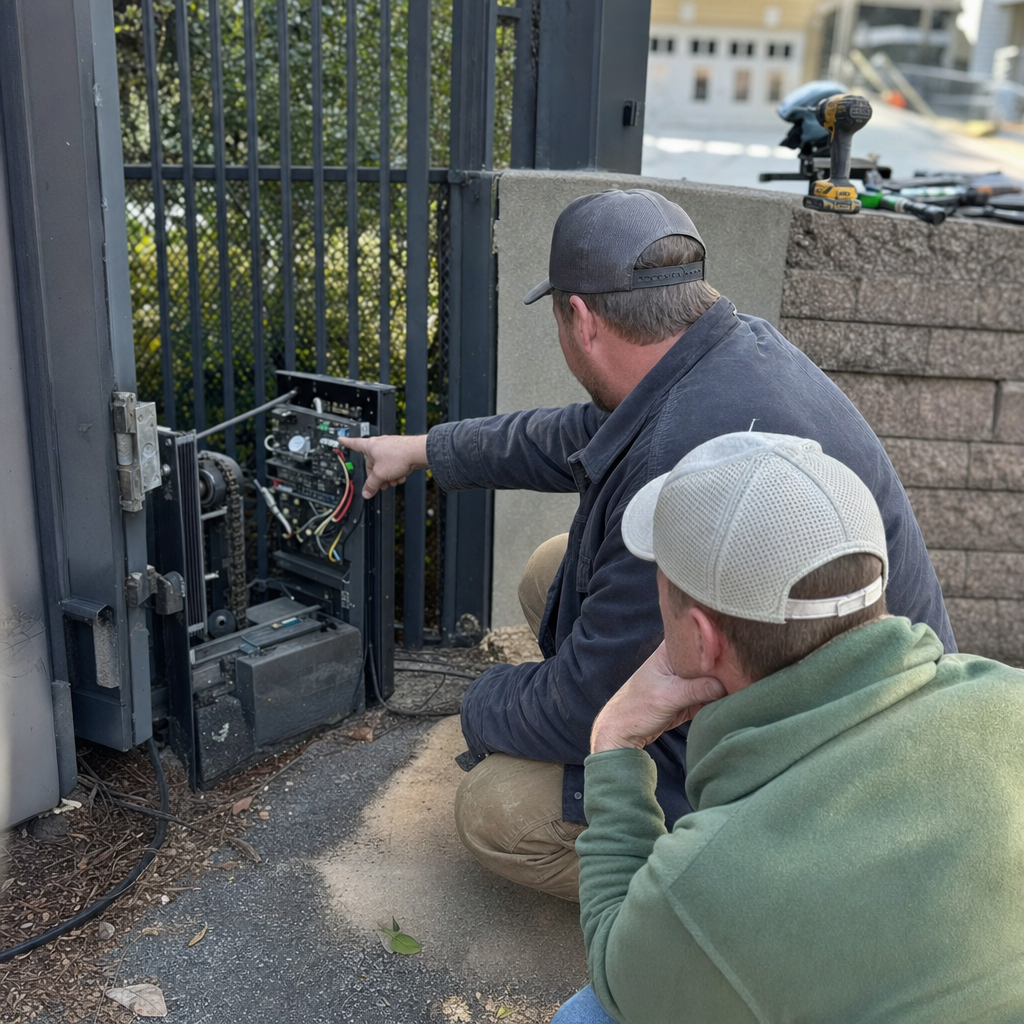
The control board is a printed circuit assembly with relay outputs, timer circuits, and input terminals for every peripheral: keypad, intercom, loop detector, safety photocell, and limit switches. When you punch a code or a car rolls over the induction loop, the board receives a simple closed-circuit signal and executes a preprogrammed sequence — open, pause, close, with safety overrides.
Here’s what most competitors won’t tell you: despite different branding, most residential gate openers share the same control-board logic architecture. A DoorKing and a Mighty Mule use different connectors and housing shapes, but the relay logic — which input triggers which output, how the safety interrupt behaves — follows nearly identical patterns. That’s why brand-agnostic diagnostic thinking works faster than hunting brand-specific manuals for every call. Frank Hughes is factory-trained across all nine brands, so we recognize the pattern before we reach for the part number.
What failure looks like:
- Gate ignores keypad but responds to remote — failed input terminal or corroded ribbon cable, not a motor problem
- Gate opens fine but won’t close — safety photocell circuit stuck in “obstruction detected” mode, often from misalignment or spider webs in Georgia’s humid summers
- Random opening at 3 AM — control board timer or limit switch drift, sometimes caused by voltage fluctuation from Georgia Power grid events
We stock rebuilt and new control boards for all major brands, and we can often repair a failed terminal block or replace a relay instead of swapping the entire assembly.
System 3: Motor and Drive — The Muscle That Moves the Gate
This is where gate type determines mechanics. There are three actuation designs, each with distinct failure modes and maintenance needs:
| Gate Type | Actuation Method | Typical Georgia Repair Cost | Common Failure |
|---|---|---|---|
| Swing gate (single or dual) | Linear arm (articulated or piston) or underground hydraulic ram | $340–$680 arm replacement; $850–$1,400 ram rebuild | Worn bronze bushing in arm joint; hydraulic seal failure in ram |
| Slide gate | Rack-and-pinion motor drive with chain or direct gear | $280–$520 motor rebuild; $180–$340 rack section replacement | Stripped nylon drive gear; rack misalignment from track settling in Georgia clay |
| Overhead / vertical lift | Screw drive or belt drive with counterbalance | $420–$760 screw assembly; $240–$480 belt and pulley | Dry screw with galling; UV-degraded belt from Georgia sun exposure |
The linear arm on a swing gate is the most common residential setup we see in Georgia’s established neighborhoods. The arm attaches to a pivot point on the gate and extends/retracts to push or pull. Inside, a worm gear reduces motor RPM to usable torque. The bronze bushing at the gate pivot wears first — it’s a sacrificial part designed to fail before the expensive gear — but many homeowners don’t recognize the grinding sound as maintenance-needed until the gear itself is damaged.
Underground hydraulic rams, popular for aesthetic reasons in upscale Buckhead or Ansley Park estates, fail differently. The cylinder sits in a submerged housing, and Georgia’s high water table means any breach of the shaft seal eventually fills the housing with muddy water. The motor runs but can’t develop pressure. Rebuilding the ram requires excavation, which is why we always inspect the breather tube and drainage design during service calls — prevention beats excavation.
Slide gates in commercial settings along Georgia’s industrial corridors — I-85, I-285 perimeter — use rack-and-pinion drives. The motor turns a pinion gear that engages a toothed rack welded to the gate. When the rack settles or the track shifts in expanding clay, the pinion skips teeth, chews the rack, and eventually strips the drive gear. We realign the track, replace the damaged rack section, and upgrade to a steel pinion if the original was nylon. It’s a full-scope repair, not a band-aid, which is why we handle welding and fabrication in-house instead of calling a second contractor.
System 4: Safety Sensors — The Nervous System That Protects People and Vehicles
Every automatic gate opener sold in the U.S. must comply with UL 325 safety standards, which mandate specific sensor configurations: photocells (infrared beams) across the gate opening, edge sensors on the leading edge, and in some cases loop detectors embedded in the driveway. These devices don’t move the gate; they tell the control board when not to move it.
In Georgia’s pollen season — roughly March through May — we get dozens of calls for “gates that won’t close.” Nine times out of ten, the photocell lens is coated in yellow pine pollen. The beam can’t transmit, the control board reads “obstruction,” and the gate stays open. It’s a thirty-second cleaning job that some competitors diagnose as a control board failure. We’re straight about it: if that’s all it is, we’ll show you how to check it yourself next time.
Loop detectors are more subtle. The induction loop embedded in your driveway senses metal mass (your car) and signals the control board to hold the gate open or trigger auto-open. In Georgia, where asphalt driveways soften in summer heat, the loop wire can shift, break, or short against rebar. The symptom is a gate that ignores vehicles or opens for no reason. We use a loop integrity tester to isolate wire breaks before we cut any asphalt — no guesswork, no unnecessary destruction.
Access Control: The Fourth Layer Homeowners Misunderstand
Keypads, intercoms, telephone entry systems, and smartphone apps feel like separate technologies, but electrically they’re simple input devices. They all do one thing: momentarily close a circuit that tells the control board “open now.” When your intercom stops working, the gate motor is almost certainly fine. The problem is in the intercom’s power supply, its communication wire, or its relay output.
We’ve replaced perfectly good LiftMaster gate operators because a previous technician couldn’t diagnose a failed DoorKing intercom relay. That’s backwards. At Beacon Gate Repair Georgia, we trace the signal path from keypad to control board terminal, identify where it stops, and fix that component. It saves our customers hundreds of dollars and reflects how we actually think about these systems: symptom → system → component, not “replace the obvious thing and hope.”
Phone-app systems add a wireless bridge — typically WiFi or cellular — between your smartphone and a receiver wired to the control board. In Georgia’s rural properties, where cellular signal is weak and broadband may be satellite-based, the weak link is often connectivity, not the gate hardware. We test the full chain, including running a temporary wire to prove the motor works before we recommend infrastructure upgrades.
What Proper Installation Looks Like in Georgia Conditions
We’ve opened enough failed installations to know the shortcuts. Here’s what we check and correct:
- Conduit burial depth: 18 inches minimum in undisturbed soil, with sand bedding and warning tape. In Georgia’s freeze-thaw clay, shallow conduit heaves, cracks, and admits water.
- Drip loops and weep holes: Every wire entering a housing needs a loop below the entry point so condensation drips off instead of running in. Control board enclosures need weep holes at the bottom — paradoxically, a sealed box traps humidity and corrodes faster than a vented one.
- Grounding: Georgia’s lightning density is among the highest in the nation. A proper earth ground at the gate post, bonded to the house ground, protects control boards from surge damage. We find ungrounded installations constantly.
- Motor thermal protection: In direct Georgia sun, a black operator housing can reach 140°F internally. Quality motors have thermal cutouts; cheap ones burn up. We specify and install units rated for continuous duty at 50°C ambient.
Frank Hughes grew up in Midtown Atlanta and learned his mechanical foundation through the welding and industrial maintenance program at Gwinnett Technical College — practical training that no YouTube tutorial replaces. When he evaluates an installation, he’s looking at conduit slope and weld penetration, not just whether the gate moves. “If I can’t explain what’s wrong with your gate in plain English, I haven’t looked at it closely enough.”
When to Call a Professional vs. What You Can Check Yourself
We’re not going to pretend every gate problem needs a truck roll. Here’s the honest split:
Safe to check yourself: Photocell alignment and cleaning; transformer LED status; remote battery replacement; visible obstruction in track or arm path; GFI reset inside the house.
Call Beacon Gate Repair Georgia: Any work inside the operator housing involving line voltage or control board terminals; hydraulic ram service; track realignment or welding; loop detector replacement requiring asphalt cutting; any symptom involving the gate moving unexpectedly or with erratic force — these are genuine safety hazards, and UL 325 exists because people have been seriously injured by uncontrolled gate movement.
We offer free estimates because we’d rather diagnose correctly than sell you parts you don’t need. Eight years. One trade. Gates only. That’s why our 570 verified reviews average 4.7 stars — customers recognize when the person who answers the phone is the same person who shows up with the tools.
FAQs
Most residential gate opener repairs in Georgia range from $180 for a simple photocell or transformer replacement to $680 for a linear arm or control board swap, with complex commercial slide-gate motor rebuilds reaching $1,400. We provide upfront pricing after diagnosis, not vague ranges that balloon on the invoice. Call (833) 863-4140 for a free estimate at your property — we’ll test all four systems and tell you exactly which one needs attention.
This almost always indicates a safety sensor circuit stuck in “obstruction detected” mode — typically misaligned or dirty photocells, a failed edge sensor, or a loop detector reading constant vehicle presence. The control board is working correctly; it’s doing exactly what it’s programmed to do when it thinks something’s in the way. We see this weekly in Georgia’s pollen season and after heavy rains shift sensor mounts. Before you call, check that the photocell LEDs are aligned and lit; if that doesn’t resolve it, we’ll bring our alignment tools and replacement sensors.
Most existing swing and slide gates can be retrofitted with automatic openers if the gate structure, hinges, and posts are in sound condition — but “sound” has a specific meaning. We won’t install an operator on a gate with sagging hinges, rotten wood posts, or a slide track that’s settled more than half an inch out of level, because the motor will fight the mechanical problem and fail prematurely. We assess the full gate structure during our estimate and can repair or reinforce as needed, including welding and fabrication, before the opener goes on. From a broken weld to a full access control system, we handle every part of the job in-house.
A quality residential gate opener properly installed and maintained should deliver 10–15 years of service in Georgia, but we’ve seen cheap units fail in 3 years and premium units last 20. The difference is installation quality and maintenance discipline: keeping photocells clean, lubricating the arm pivot annually, checking conduit integrity after freeze-thaw cycles, and replacing the transformer before voltage sag damages the control board. We work on virtually every major gate brand, so we diagnose fast and fix right — and we’ll tell you honestly when your existing unit has enough life left to justify repair versus replacement.
Get a Straight Answer and a Lasting Fix
If you’d rather have it looked at, Beacon Gate Repair Georgia offers a no-pressure assessment anywhere in Georgia — call (833) 863-4140 for a free estimate. Frank Hughes, Owner & Lead Technician, answers your call, runs the diagnosis, and stands behind the repair himself.
Written by Frank Hughes, Owner & Lead Technician at Beacon Gate Repair Georgia, serving Georgia, GA.