
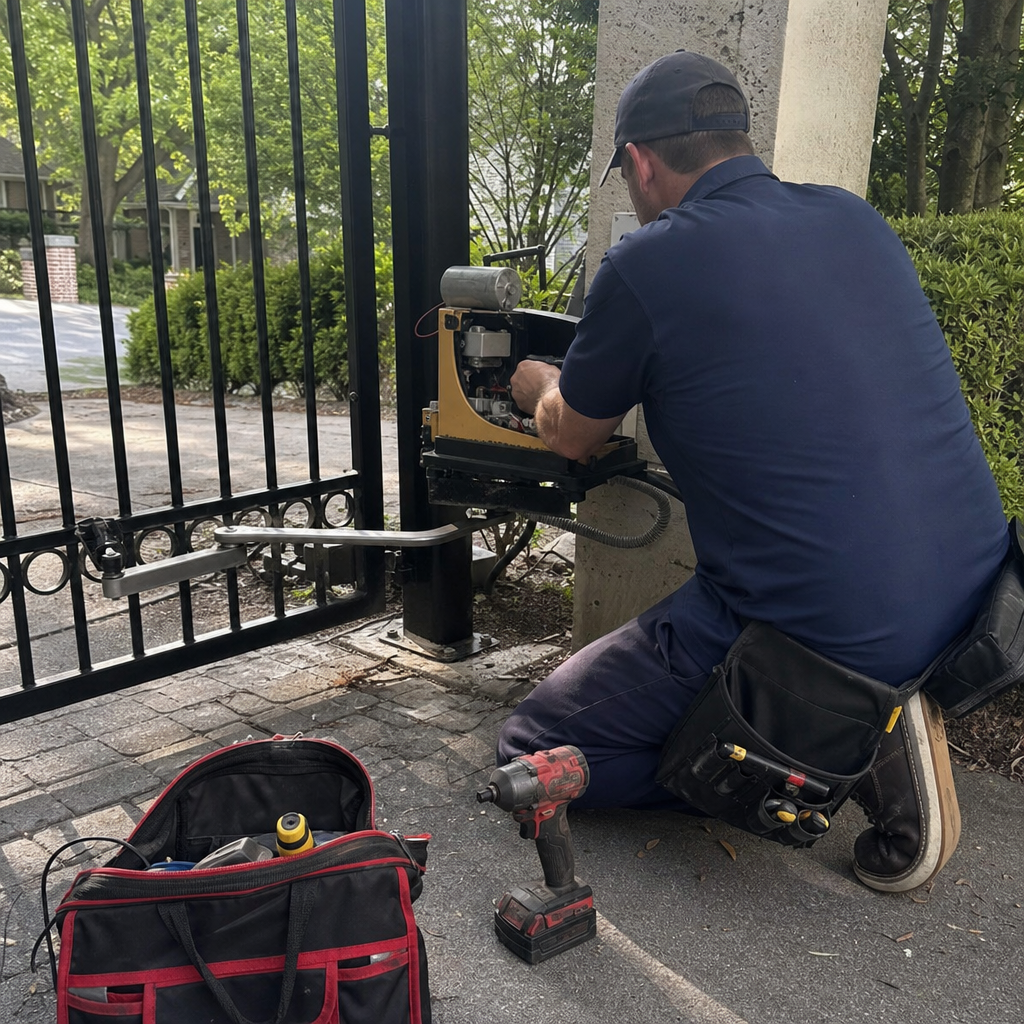
Electric Gate Repair Cost in Georgia: What You’ll Actually Pay Based on What’s Broken
Electric gate repair in Georgia typically runs between $120 and $1,400 depending on which of the three systems failed — power supply, control logic, or mechanical actuation. Most residential calls we handle in the Georgia area fall in the $180–$650 range. Call (833) 863-4140 for a free estimate and same-day diagnosis.

Here’s the problem: the symptom almost never tells you which system is at fault. A gate that reverses mid-swing could be a $120 loop sensor adjustment or a $680 motor replacement. The difference matters, and after eight years of running Beacon Gate Repair Georgia, we’ve learned that homeowners who understand this three-system breakdown get fairer quotes and faster fixes. Frank Hughes — Owner & Lead Technician — takes your call and works your job, so you get the diagnostic experience directly, not filtered through a dispatcher.
Why Electric Gate Costs Vary So Widely: The Three-System Problem
Every electric gate is really three separate machines sharing one frame. That’s why “my gate doesn’t work” can mean wildly different bills.
Power supply covers everything from your household breaker to the transformer at the gate post to the low-voltage wiring running underground. Control logic is the board, the safety sensors, the loop detectors, and the keypad or remote receiver. Mechanical actuation is the motor, gearbox, drive arm, wheels, and track.
When your gate fails, all three systems are suspects until proven otherwise. A generalist handyman might swap parts blindly. An electrician might fix the 110V line voltage but miss the failed limit switch. That’s the “two-tech problem” we see constantly in Georgia — miscommunication between trades causes duplicate trip charges and sometimes conflicting fixes. One specialist who understands all three systems eliminates that waste.
We work on virtually every major gate brand, so we diagnose fast and fix right. Frank carries diagnostic cables for all nine brands he’s factory-trained on — LiftMaster, FAAC, BFT, Linear, Viking, Ghost Controls, DoorKing, Elite, and Mighty Mule — which means he reads error codes directly from the control board rather than guessing from symptoms. Faster diagnosis, lower labor cost.
Symptom-to-System Map: What Your Gate Is Telling You
Use this to have an intelligent conversation before the tech arrives. We’ve built this from eight years of Georgia gate calls, tracking what actually fails and what it costs to fix.
| What You’re Seeing | Most Likely System | Typical Repair | Cost Range |
|---|---|---|---|
| Gate reverses mid-travel or won’t close fully | Control logic: loop sensor or obstruction detection misreading | Sensor adjustment, loop replacement, or debris clearing | $120–$200 |
| Gate hums but doesn’t move | Mechanical: capacitor failure or seized gearbox | Capacitor replacement or gearbox rebuild | $180–$450 |
| Gate is completely unresponsive (no lights, no sound) | Power supply: tripped breaker, failed transformer, or control board | Transformer replacement or board repair | $200–$650 |
| Gate drifts open slowly over time | Mechanical: limit switch failure or brake wear | Limit switch adjustment or brake assembly replacement | $150–$380 |
| Gate moves erratically or stops at random positions | Control logic: failing control board or corrupted programming | Board replacement or reprogramming | $350–$650 |
| Remote works intermittently or only at close range | Control logic: receiver antenna or remote pairing issue | Receiver replacement or reprogramming | $120–$280 |
When your electric gate stops mid-swing and reverses, 70% of the time it’s the safety loop sensor reading ghost signals — a $120–$200 fix. The other 30% is a failing motor capacitor. The reason it matters: the repair approach is completely different, and a tech who assumes motor will charge you for both. “If I can’t explain what’s wrong with your gate in plain English, I haven’t looked at it closely enough.” That’s the standard Frank works to on every Georgia call.
Georgia’s Hidden Cost Driver: Lightning and Surge Damage
Georgia’s afternoon lightning storms — especially the fast-building cells that roll through from late spring through early fall — cause more control board surge failures than any other single failure mode we’ve tracked across eight years of Georgia gate calls. Most homeowners don’t realize a $25 surge protector at the gate post would have prevented a $400 board replacement.
The damage pattern is specific: the surge travels through the transformer or the low-voltage loop wiring, fries the board’s input protection, and sometimes cascades into the motor driver circuit. After a storm, we get clusters of calls from the same neighborhoods — Johns Creek, Alpharetta, the lake communities around Lanier — where the ground conductivity and above-average lightning density create perfect conditions for gate system damage.
If your gate failed within 48 hours of a thunderstorm, mention it when you call. It changes our diagnostic sequence and sometimes saves you money if the board is partially recoverable.
Common Local Scenarios We See in Georgia
These aren’t hypotheticals. These are the actual situations Frank Hughes has handled personally across Georgia’s varied housing stock — from 1990s ranch homes with original Mighty Mule swing gates to new construction communities in Forsyth County with integrated LiftMaster systems.
The HOA Gate That “Just Started Acting Up”
Property managers in Georgia’s master-planned communities call us when the main entry gate starts reversing on residents during morning rush. The cause is almost always loop detector drift — the sensitivity setting creeps over months of temperature cycling until the system sees phantom vehicles. It’s a 20-minute adjustment if you know which dial to turn and which brand’s detector board you’re working with. We’ve serviced enough DoorKing and Elite systems in Georgia HOA entries to know the common failure curves.
The Farm Gate That Won’t Open After a Wet Winter
North Georgia’s clay-heavy soils and freeze-thaw cycles heave gate posts and shift underground conduit. The gate itself is fine; the low-voltage wiring between post and operator has corroded or pulled loose. We trace the break with a tone generator, repair or replace the run, and often recommend upgrading to direct-burial-rated cable with waterproof splices. The mechanical guys miss this because they’re looking at hinges and wheels.
The “Upgraded” Gate With a Mismatched Opener
Homeowner buys a heavy-duty Gate Repair candidate — wrought iron, custom fabricated, beautiful — then pairs it with a residential-grade operator from a big-box store. The motor strains, overheats, fails prematurely. We see this on custom gates in Georgia’s established neighborhoods like Virginia-Highland and Decatur. The fix isn’t another cheap motor; it’s properly sizing the operator to the gate’s weight, wind load, and duty cycle. Frank does that calculation on-site and sources the right unit.
The Commercial Slide Gate That Drifts
Warehouse and distribution gates in Georgia’s logistics corridors — especially around the airport and the I-85 corridor — take heavy cycles. The brake assembly in the operator wears, the gate drifts open a few inches, and suddenly you’ve got a security breach at 2 AM. Limit switch failure presents similarly. We diagnose which it is before quoting, because the parts and labor differ significantly.
When Repair Costs More Than Replacement: The Honest Threshold
There is a point where electric gate repair stops making financial sense. We’re upfront about it because Frank Hughes has no interest in collecting a repair fee for a gate that’ll fail again in six months.
If the control board and motor both need replacement on a unit over eight years old, new installation often costs less than the sum of parts plus labor. The installed base price for a quality residential swing gate operator in Georgia runs $1,800–$3,200 depending on weight capacity and features. Two major component failures on an aging system can push repair costs toward $1,400–$1,800 with no warranty on the remaining original parts.
We’ll say so on-site. We’ll also tell you if the gate structure itself is sound enough to justify a new operator, or if the posts, hinges, or track need attention that would affect a new installation quote. From a broken weld to a full access control system, we handle every part of the job in-house — no subcontractor handoffs that inflate cost and dilute accountability.
What Drives Cost Up (and What Doesn’t)
- Brand-specific parts: FAAC and BFT components often carry longer lead times and higher parts costs than domestic brands. We stock common failure items for all nine brands to minimize delay.
- Underground wiring damage: If the low-voltage run between house and gate has failed, trenching and conduit replacement adds $400–$900 depending on distance and obstacles.
- Access control integration: Adding or repairing keypad, intercom, or cellular entry systems runs $350–$1,200 depending on complexity.
- Structural welding: Gate frame cracks, broken hinges, or post separation require portable welding — we do this in-house, not through a third-party fabricator.
- Emergency after-hours calls: We don’t charge a separate “emergency fee,” but after-hours labor rates apply for calls outside 7 AM–6 PM. Most Georgia customers with a stuck-open gate prioritize same-day scheduling over midnight service.
Eight years. One trade. Gates only. That focus means we carry the diagnostic tools, parts inventory, and brand-specific training to complete most repairs in a single visit. The general fence company that “also does gates” makes two trips: one to look, one to return with parts they guessed at.
Safety Note: Live Electrical and Heavy Mechanical Components
Electric gates operate on 110V line voltage and contain high-torque mechanical systems that can cause serious injury. Capacitors in the operator retain charge even when disconnected. The gate itself can weigh 400–1,200 pounds and move with enough force to trap or crush. We do not recommend DIY troubleshooting beyond visual inspection of obvious obstructions and checking your household breaker. Diagnostic work on the electrical or mechanical systems should be performed by a trained professional with proper lockout/tagout procedures. Call (833) 863-4140 — we’ll walk you through what’s safe to check and what isn’t.
FAQs
Most electric gate repairs in Georgia cost between $180 and $650, with simple sensor or programming fixes at the low end and motor or control board replacement at the high end. Call (833) 863-4140 for an exact quote — estimates are free.
Repair is cheaper if only one major component has failed and the gate structure is sound; replacement becomes the better value when both the control board and motor need replacement on a system over eight years old. Frank Hughes assesses this honestly on-site and will recommend replacement if the math favors it.
We complete most electric gate repairs same-day because we carry diagnostic equipment and common parts for all nine major brands we service. Same-day availability depends on parts needed and your location within our Georgia service area — call (833) 863-4140 to confirm.
Georgia’s lightning storms frequently cause surge damage to gate control boards and transformers, which is the most common storm-related failure we see. A surge protector at the gate post typically prevents this $400 repair for under $30.
Get a Straight Answer on Your Electric Gate Repair Cost
Stop guessing what’s wrong and stop getting quotes from techs who guess too. Frank Hughes — Owner & Lead Technician at Beacon Gate Repair Georgia — will diagnose your gate personally, explain the three-system failure in plain terms, and give you a fixed repair price before any work begins. 570 neighbors have trusted us with their gates — here’s what they said. Call (833) 863-4140 for your free estimate today.
Written by Frank Hughes, Owner & Lead Technician at Beacon Gate Repair Georgia, serving Georgia, GA.